Tracker tickets
Vectispire opens tickets in GitLab, GitHub, Jira or ServiceNow — one per problem that would fail a build.
One threshold, defined once
Ticket creation uses the same gate policy as the CI gate.
That is the design decision worth understanding. A separate ticketing threshold would mean two bars to keep in step, and they would drift: teams would end up with tickets for things that do not fail their build, or a red build with no ticket behind it. One policy, one answer. See Gate policies.
No duplicates, ever
The tracker reference is kept on the issue.
So a tracker outage is retried rather than lost, and the retry finds the existing reference and does not open a second ticket. The same issue seen on fifty consecutive nightly scans is one ticket.
A reference somebody attached by hand is never overwritten: if it arrives while the sweep is
opening a ticket for the same issue, the issue keeps the person's, and the ticket just opened is
named in the log and in its TICKET_CREATED audit entry as not recorded on the issue — it
exists in the tracker, and may need closing there.
Configuring
Under Settings: the tracker type, its URL, the project or
target, and a token. The URL, the project and the Jira account are an administrator's, like the
token: the token acts wherever they point it. A GitHub project is owner/repository and nothing
else — a path after it is refused when saved, and refused again at the send for a value stored
before.
Give the token the narrowest scope that can create and read issues in the target project.
It is stored encrypted with your ENCRYPTION_KEY, and storing it is refused before that
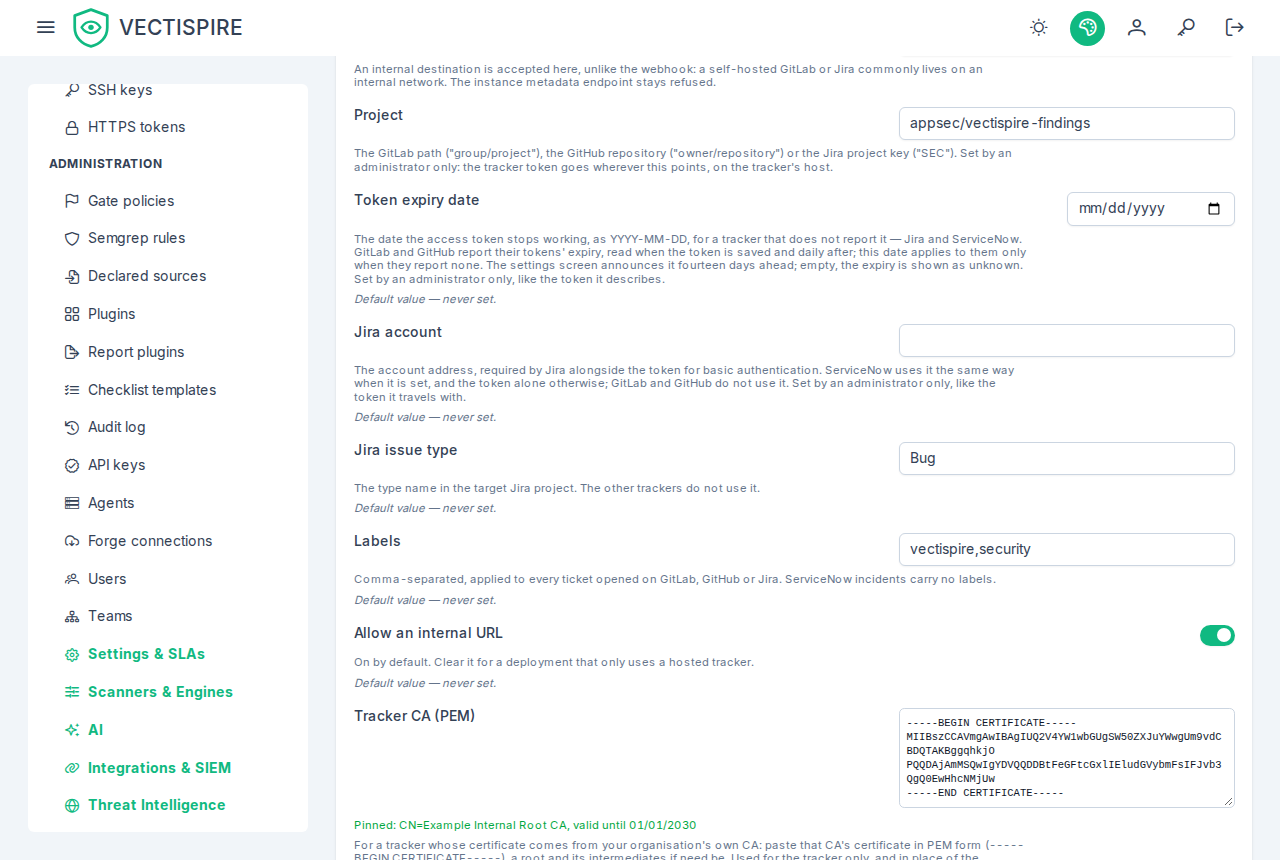
key exists. A tracker whose certificate comes from your own CA needs that CA pinned —
below.
A tracker behind an internal CA
A self-hosted GitLab, Jira Data Center or ServiceNow on your network often carries a certificate issued by your organisation's own CA, which the Java runtime's trust store does not hold. Before 0.11.0 every call to it failed the TLS handshake: no ticket was opened, and the hourly sweep retried without saying why anywhere but the server log.
Paste that CA's certificate, in PEM (-----BEGIN CERTIFICATE-----), into Settings → Tracker →
Tracker CA (PEM) — the root, and its intermediates if your server does not send them; up to 8
certificates and 16,384 characters. To get it, ask whoever runs your PKI for the issuing CA's
certificate, or read the chain the tracker presents —
openssl s_client -connect gitlab.example.internal:443 -showcerts < /dev/null — and keep the
certificate of the CA at the top of it, not the server's own (the first one printed).
- It applies to the tracker only. Every call the integration makes — opening a ticket on any of the four trackers, closing it, Jira's list of transitions, ServiceNow's incident lookup — is verified against it; nothing else Vectispire connects to trusts it.
- It replaces the runtime's store for the tracker, it is not added to it — the same rule as a forge connection's and the SIEM collector's CA. The public CAs are then not trusted for the tracker: a certificate some public CA issued for its name does not pass. Leave the field empty for a tracker with a public certificate.
- The tracker's name is still verified: its certificate must name the host of the tracker URL. There is no "skip verification", which would hand the token to whoever answers first.
- The save refuses what would not work or would trust too much, in the forge connections' words: a certificate that is not a CA (the server's own), one that has expired or is not yet valid, one whose key usage forbids signing certificates, anything that is not a certificate — a private key pasted by mistake is refused and not echoed back.
- It is an administrator's, like the URL: it decides whom the tracker token is presented to.
Other roles see the field read-only and without its value. Saving it is audited
(
ticket_ca_pem changed) and forwarded to the SIEM as a security setting change. - Shown by its subject and expiry. Past that date the CA is not trusted any more: no ticket is opened or closed, the server log says the tracker CA expired, and the fix is to paste the renewed CA.
When the token expires, or stops working
A tracker token does not last: GitLab now gives every token an expiry, a year at most by default. Before 0.11.0 the day it lapsed the hourly sweep failed on every call, with a line in the server log as the only trace, and no ticket was opened or closed again until somebody noticed.
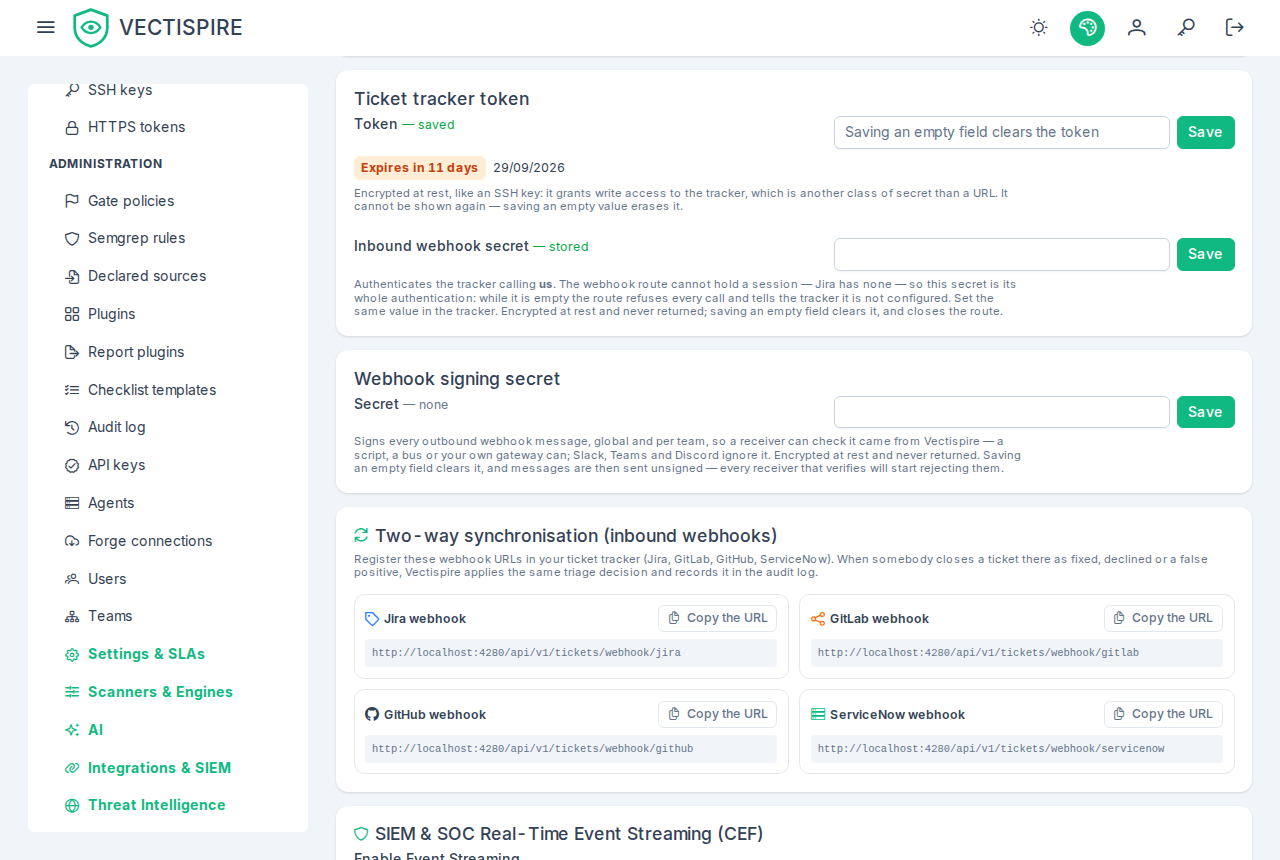
The tracker card under Settings → Integrations now shows the token's life, as the forge connections' list shows a connection's:
- Its expiry, announced fourteen days ahead — Expires in 9 days, then Expired. GitLab reports
it (
GET /api/v4/personal_access_tokens/self, for personal, group and project access tokens) and GitHub too (thegithub-authentication-token-expirationheader of an authenticated call); both are asked when the token is saved and once a day after, through the tracker's pinned CA when one is set. Jira and ServiceNow have no reliable way to say: enter the date yourself in Token expiry date (ticket_token_expires_on,YYYY-MM-DD, administrator-only), which also applies to a GitLab or GitHub token that reports none. Neither known, the card says Expiry unknown rather than nothing. - That it stopped working. When the tracker answers a call of the sweep with
401or403— an expired, revoked or under-privileged token — or the daily check with401, the card says Stopped working with the status and since when, before any date. GitHub's rate limit, which also answers403, is not a refusal: a403carryingx-ratelimit-remaining: 0orretry-after, and any429, leave the card as it was, and the next hour's sweep tries again. It goes back to normal at the next call the tracker accepts, or when a new token is saved, which forgets everything known of the previous one.
Each change is written once to the server log at WARN — entering the fourteen days, expiring,
being refused, accepted again — never once an hour while nothing changes. Nothing is sent to a
notification channel or the SIEM, as for a forge connection's token: the screen and the log are where
it is said. GET /api/v1/settings/ticket-token answers expiresAt, expirySource (reported,
declared or unknown), refusedStatus, refusedSince and checkedAt beside configured, and
PUT answers the same once the tracker has been asked.
What lands in the ticket
Enough to act without opening Vectispire: the component and version, the identifier, the severity, whether a fix exists, EPSS and KEV status, and a link back to the issue.
Closing the loop
Closing the ticket in the tracker does not resolve the issue in Vectispire — state is
written only by the pipeline, from what the scanners observe. Fix the dependency, and the
next scan resolves it.
The other direction is automatic: when a scan resolves an issue, Vectispire closes the ticket it
opened for it. Each tracker is called with the verb its API routes for an update — PUT on
GitLab, PATCH on GitHub and ServiceNow, a transition on Jira — the one the issue's own workflow
offers towards a status in the done category, asked of Jira each time rather than assumed. ServiceNow addresses a record by
its sys_id, while the reference Vectispire keeps is the incident number people read
(INC0012345), so the number is first looked up in the incident table: the ServiceNow account
needs read access to incident as well as write.
If it is not going to be fixed, that is a triage decision: will not fix — risk accepted, with a review date and no VEX justification, since the product stays exposed.
The inbound webhook
A tracker can also call Vectispire back, at POST /api/v1/tickets/webhook/{provider} —
gitlab, github, jira or servicenow. When a ticket Vectispire knows by its reference is
closed as not going to be fixed or as a false positive, the call proposes a decision on the
issue; any other update is only recorded in the audit log. The two closings are different claims, and
they are proposed as different statuses
(decision 0041):
| The ticket is closed as | Proposed status | Justification |
|---|---|---|
a refusal — Jira Won't Fix, Declined, Rejected; ServiceNow Won't Fix, Risk Accepted, Withdrawn; GitHub not planned (state_reason: not_planned); GitLab closed with wontfix or won't fix in its title |
will_not_fix |
none, and a review date proposed ninety days out |
| an explicit false positive — Jira False Positive, Cannot Reproduce; ServiceNow False Positive, Not an Issue; the words false positive in a GitHub issue's body or a GitLab issue's title or description | not_affected |
vulnerable_code_not_in_execute_path |
A refusal is never proposed as not_affected. It says the team will not fix the vulnerability,
not that the product is safe from it; before 0.11.0 it was proposed as not_affected with
inline_mitigations_already_exist, a mitigation the tracker never mentioned, which the signed
documents would have carried once approved. GitHub's not planned is its only way to close without
completing, and says nothing about reachability, so it is a refusal and no longer a false positive.
It is refused until a secret is set. The route is the only one open without an account —
the tracker holds no session — so the secret is its whole authentication. While
Settings → Tickets → Inbound webhook secret is empty, every call is answered 403 with
"The ticket webhook is not configured on this instance", which is what the tracker's delivery
log shows. Set the secret, then the same value in the tracker, presented the way that tracker
presents one:
| Tracker | Header | What it carries |
|---|---|---|
| GitLab | X-Gitlab-Token |
the secret itself, GitLab's own Secret token field |
| GitHub | X-Hub-Signature-256 |
sha256= and the HMAC-SHA256 of the raw body, GitHub's own Secret field |
| Jira, ServiceNow | X-Vectispire-Token |
the secret itself — neither has a convention, so this header is accepted for those two and no other |
A wrong or missing header is answered 401, with no detail on which header was expected. A
stored secret that no configured key can decrypt refuses the same way: set it again.
A delivery is acted on once. The hash of each accepted body is kept for thirty days; the same
body arriving again within that window — a replay, or the tracker's own redelivery — is answered
200 "Delivery already processed" and changes nothing.
A decision is queued, never applied. The issue moves to pending_approval with the proposed
status and its justification, and stays under investigation in the exported VEX documents until a
second person approves it under four-eyes. The request keeps the
status the tracker asked for (triageRequestedStatus): the approver grants that status — a Won't
Fix as will_not_fix, never as not_affected — or turns the request down, and sets the review date,
which the dialog proposes from the request. The author recorded is
the integration (GITLAB_webhook, …); the name the tracker reports goes into the comment, as
reported data rather than as an identity.
A decision a person settled is not moved by a ticket. On an issue already not_affected,
will_not_fix or fixed, the tracker's word is recorded in the audit log and nothing changes. When
it disagrees with the settled status — Won't Fix on an issue cleared as not affected, a false
positive on an accepted risk — the entry is TRIAGE_CONTRADICTED_BY_TRACKER, sent to the SIEM as
VECTI-SEC-037: one of the two is wrong, and only a person can say which.
A tracker that agrees is audited, not signalled.
One ticket may stand for several issues. A reference attached to more than one finding — one
ticket for a CVE across several repositories — and a GitLab or GitHub number stored with or without
its # all match: every issue carrying it is synced, each with its own history and audit entry, and
the answer lists them in issueIds, oldest first (issueId is the first). Until 0.11.0 two such issues
answered 500 at every delivery.
Deliveries are limited per caller address (VECTISPIRE_WEBHOOK_REQUESTS_PER_WINDOW, see
Configuration).