Compliance
Vectispire maps what the scans observe, and what the platform itself has switched on, onto a handful of technical controls named after six frameworks, and packages the result as signed evidence.
What this is and is not
It is a mechanical evaluation of the controls Vectispire can observe: what is scanned, how often, what was found, what was decided about it, who decided, and whether the record is intact.
Each framework is represented by four technical controls — 24 in all. The frameworks are much larger: Annex A of ISO/IEC 27001:2022 alone holds ninety-three controls, and Vectispire measures a few of its technological ones. Most of what these frameworks require — governance, personnel, physical security, supplier management — is nothing a scanner can see.
It is not a compliance verdict for your organisation. It prepares an assessment; it is not one. Treat the export as evidence for the technical controls, filed alongside everything else.
| Framework | |
|---|---|
| NIS 2 | EU network and information security directive |
| DORA | EU digital operational resilience, financial sector |
| ISO/IEC 27001:2022 | Information security management |
| PCI-DSS v4.0 | Payment card industry |
| Cyber Resilience Act (EU CRA) | Product security obligations |
| SOC 2 | Trust services criteria — a SOC 2 report is an auditor's; Vectispire supplies evidence for it |
Each control is scored by its category — vulnerabilities, supply chain (the share of targets with
an SBOM), secrets, secure coding, infrastructure as code, gate governance, audit trail — so its
title names the requirement it relates to, not everything that requirement asks. CRA-ART11-NOTIF,
for instance, scores the open critical, CISA KEV-listed and overdue vulnerabilities an Article 14
notification would start from; it neither makes nor tracks the notification. The CRA codes keep the numbering of the 2022 proposal; the titles cite Regulation (EU) 2024/2847 as
adopted, whose Article 14 reporting obligation applies since 11 September 2026. The formulas are in
the compliance reference.
The same posture yields the same verdict, so a result can be reproduced.
Platform settings cap some controls
A control resting on a capability of this instance is capped — score lowered, status at best partial — while the capability is off, and the control's detail names the setting:
| When | Ceiling | Controls |
|---|---|---|
No encryption key (ENCRYPTION_KEY) |
60 | the secrets controls of every framework |
No audit mirror (vectispire.audit.mirror-path) |
70 | the audit controls: DORA-ART16-INCIDENT, PCI-REQ-10.2, SOC2-CC7.2 |
No identity provider (VECTISPIRE_OIDC_ISSUER) |
65 | the same audit controls |
An identity provider, with local password sign-in still open (VECTISPIRE_PASSWORD_LOGIN) |
85 | the same audit controls |
Four-eyes approval off (triage_four_eyes_required) |
75 | NIS2-ART21-GOV |
No data is not compliant
A control scored on the absence of findings says nothing of a target nobody looked at. Until a target
has been scanned successfully, every control that reads the estate is NO_DATA, and so is every
framework — the audit trail's control, which reads this instance's own chain, is still measured and
shown. A NO_DATA score is zero and is no measurement: the screens show a dash, the matrix leaves the
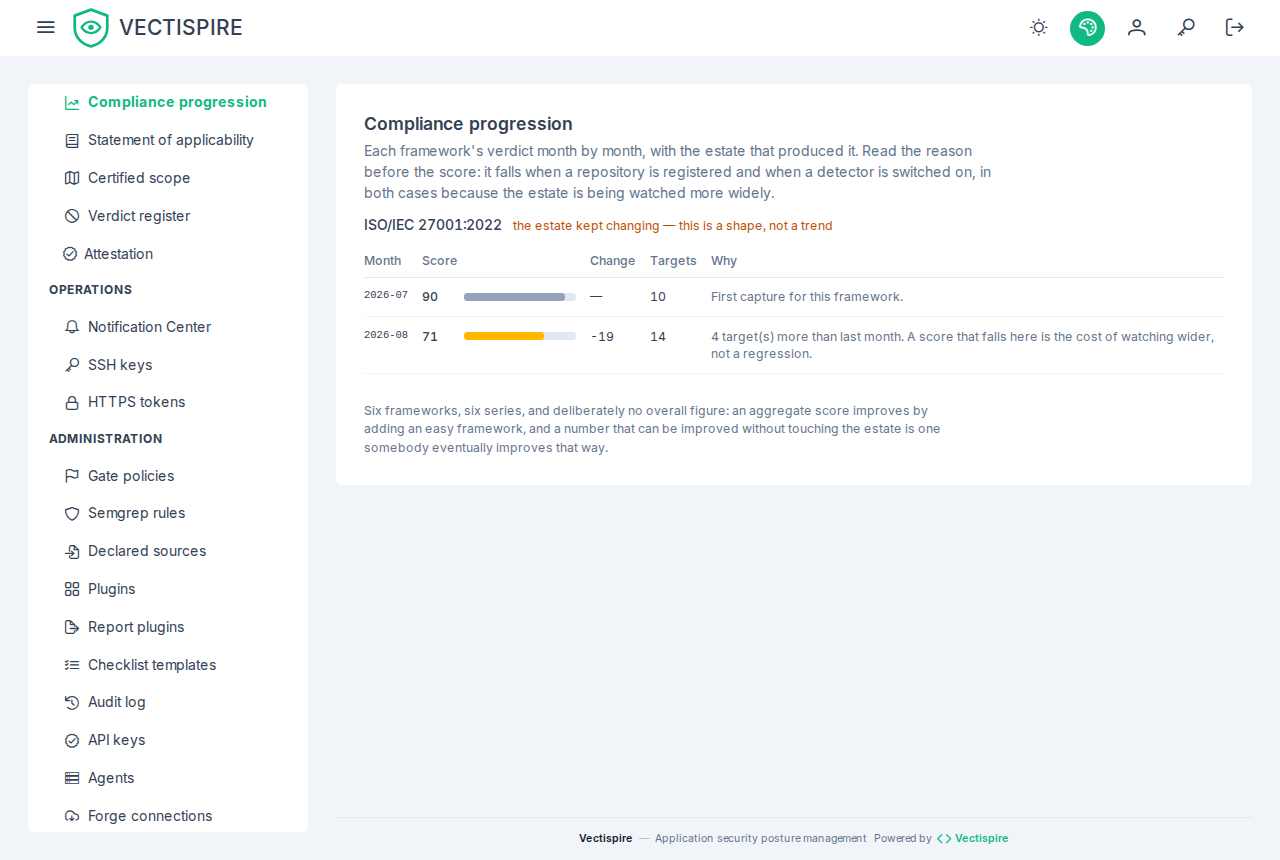
framework's column empty, the PDF reads NO DATA, and the monthly progression records no month for a
framework with nothing measured.
Once part of the estate is observed, coverage caps every control scored on the absence of findings — vulnerabilities, secrets, secure coding and IaC (ISO 27001 A.8.8, A.5.15, A.8.28, A.8.9, and their counterparts in the other frameworks): a target never scanned makes the control non-compliant, one scanned outside the freshness window makes it partial at best, and the detail says how many targets the assessment covers. Ten targets with one scanned clean is not a clean estate; it is one clean target and nine nobody looked at. A target counts as observed once it has a successful scan — whichever steps produced in it; the security checklists are where a step is measured on its own.
Per project and per solution
The same evaluation answers for one project or one solution:
It is the estate's evaluation run over the targets filed in the project (or in the solution's
projects), and over nothing else: the same controls, the same coverage and freshness caps, NO_DATA
when none of those targets was scanned — however scanned the rest of the estate is — and a
per-target matrix holding only them. A clean project in an estate full of criticals reads compliant;
the estate does not. The response carries the estate summary's shape under compliance and, under
scorecard, the scope's scorecard over the same targets: graded by its weakest link — the lowest score
among those targets, each as its own card computes it, named in weakestTarget — with the risk points of
the scope's whole open backlog. The scorecard follows the same absence: grade NO_DATA and a null
score when none of the targets holds a completed scan, and a score capped at the scanned share when only
some do, with totalTargets and observedTargets beside it (how the scorecard is computed).
The platform's own controls (encryption, the audit mirror, four-eyes, the sign-in policy) are the
deployment's and read the same in every scope.
A project you see only in part is evaluated over the part you see, and the response says so:
partial is true and targetCount says how many targets were counted. The verdict speaks for those
targets, never for the project as a whole. A project or solution you see nothing of is answered as one
that does not exist (404). Nothing of this is stored: it is computed for the read, like the estate's
summary, and the monthly progression stays the estate's.
On screen, a project's page shows its compliance and score, and Compliance & score on each
solution of the Solutions & projects
tree opens the solution's: the scorecard, then the figures, matrix, frameworks and controls of the
estate page, drawn by the same component, with Computed over N target(s) above them and, on a
partial scope, a notice that they cover only what you see. A scope none of whose targets was scanned
reads No data throughout — the frameworks and the score alike show a dash. The score's dash is the
scorecard's own NO_DATA: the scorecard starts at a hundred and subtracts what it finds, and answered
100, A+, for a scope nobody had looked at until it learned to say it had nothing to grade.
The evidence bundle
One click exports a signed evidence bundle:
An integration key restricted to some targets receives the bundle for those targets: the audit trail
and the month-by-month progression describe the whole estate, so they are left out, and the
manifest's withheld list says so.
The signature is what makes the package worth more than a screenshot. It attests that this bundle is the one Vectispire produced, unmodified — which is the question anyone reviewing evidence after the fact actually has.
Verify it against a key you obtained separately, never the 00_vectispire_public_key.pub the
bundle carries: whoever alters a bundle replaces that file too. Fetch the key from
/api/v1/crypto/public-key.pub or keep a copy pinned from before. The attestation inside is a DSSE
envelope signed over the specification's pre-authentication encoding, so cosign verify-attestation
and in-toto verifiers check it as they would any other.
Supporting records
Three other exports carry weight in the same conversation, all covered under Exports:
- the OpenVEX document, built from your triage decisions;
- the posture report per target, written for a person;
- the detection and triage history, which is the document that answers "who knew what, when".
Keeping the record intact
Compliance evidence is only as good as the log behind it. See Audit log for the hash chain, and for the mirror that puts a second copy outside the database it watches.