Container images
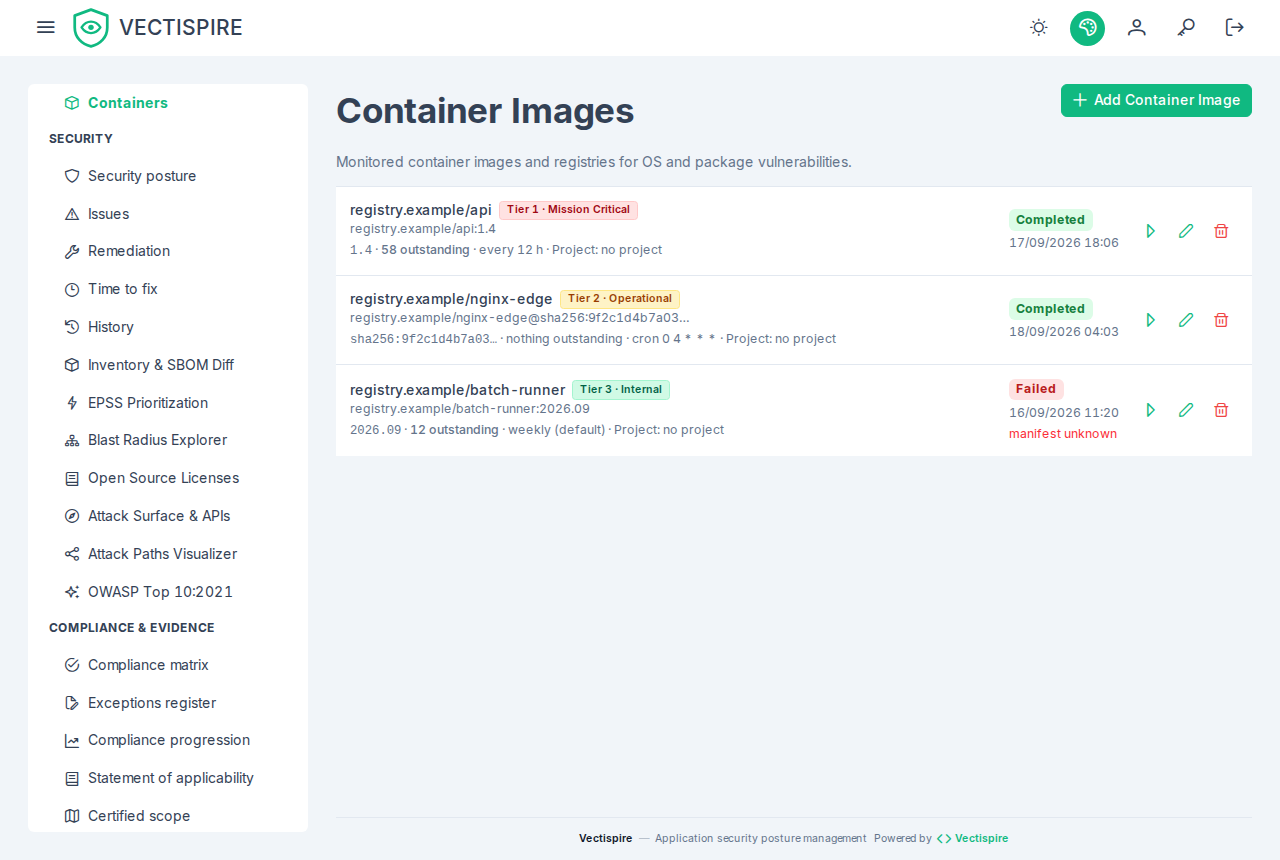
A container image is a scan target like a repository, registered on Containers with its reference — registry, name and tag or digest.
Prefer a digest where you can. A tag is mutable, so a verdict recorded against
myapp:latest is a verdict about whatever latest meant at the moment of the scan, which
is not a fact anybody can act on a week later.
What is checked
The image is catalogued by Syft and matched by Grype exactly as a repository is: same
Finding rows, same EPSS and KEV enrichment, same license evaluation, same issue
reconciliation.
One check is specific to images: the end-of-life status of the distribution the image is built on, read from the endoflife.date catalogue. It is worth stating why it matters, because it carries no CVE. A base image past its security support has no current problem you can point to; it has the guarantee that nothing will be fixed for the next one.
Coverage there is deliberately scoped to products — languages, runtimes, frameworks, distributions — rather than every library on the catalogue.
Project
Each image shows the project it is filed in, linking to that project in Solutions and projects, or no project, linking to that group. Filing is done from that screen, by an administrator, as for a repository — and it is an access change: a grant on a project covers the images filed in it.
Registry credentials
Private registries need credentials, and Vectispire does not store them: an image is pulled by
the Docker daemon on behalf of whichever executor scans it — the built-in worker or an agent — with
the credentials of that executor's own Docker configuration (DOCKER_CONFIG, by default
~/.docker/config.json of the user it runs as, an auths entry per registry as docker login
writes it). Nothing of them reaches the control plane, the database or the agent protocol. Give each
executor that may scan a private image the credentials for its registry. A configuration that keeps
them in a credential helper (credsStore, as Docker Desktop does) leaves nothing the executor can
read: write the entry into the file itself, for a read-only account.
The same credentials are used to read a plugin's signature from its registry.
Scanning and recurrence
Identical to repositories: the installation's default (weekly unless changed), an interval, a cron expression — which wins when both are set — or manual only. See Repositories.
SBOM drift between releases
Comparing two images of the same application answers the question a single scan cannot: what did this release change? The SBOM diff viewer shows packages added and pruned, license migrations — a permissive dependency that became GPL or AGPL copyleft between two tags is exactly the kind of change nobody notices in a lockfile diff — and net CVE impact.