Issues and triage
An issue is one problem, tracked across scans. It is where the work actually happens.
What identifies an issue
The fingerprint deliberately ignores the package version. A dependency that stays vulnerable through three patch releases is one issue with one history and one decision, not three issues that each need deciding again.
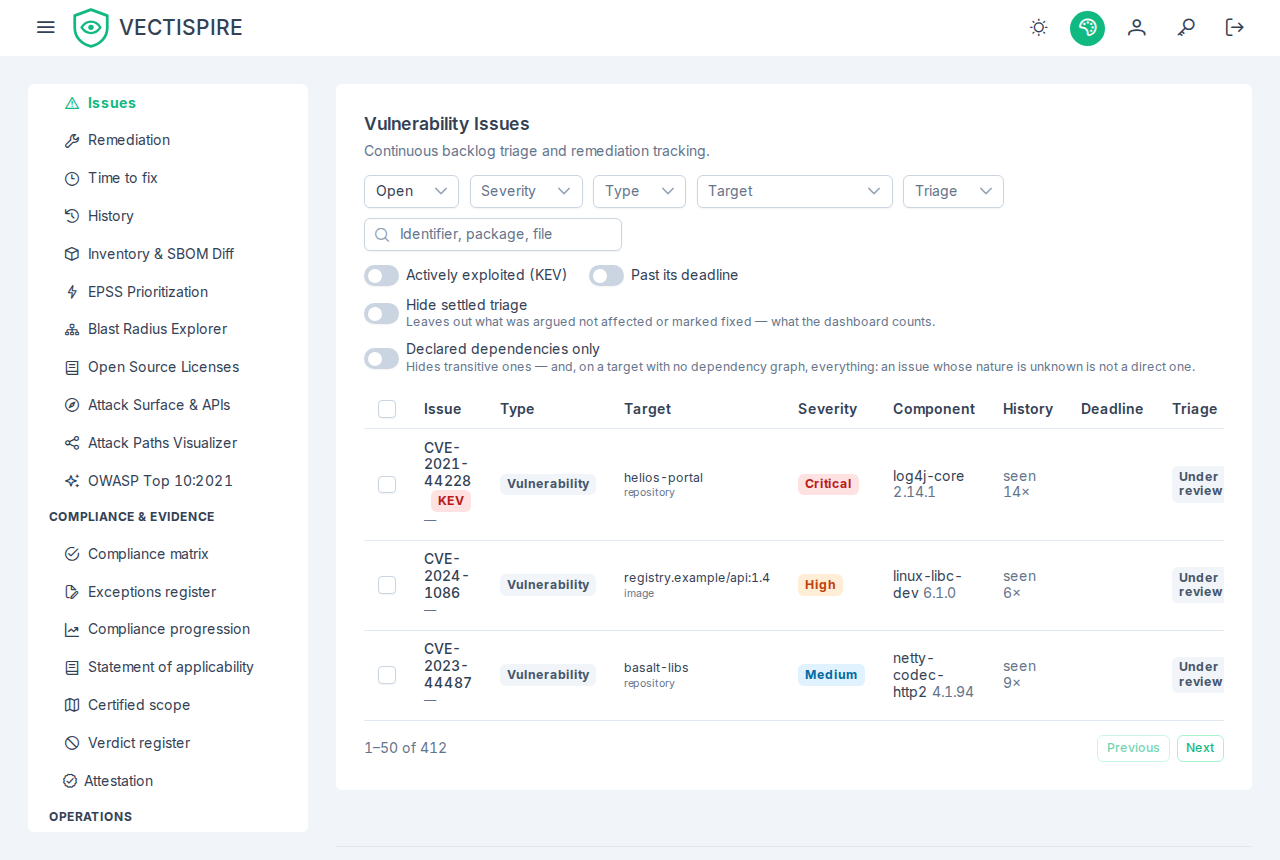
Each issue carries: when it was first seen, how many times it has been seen, whether a fix version exists, whether the package is direct or transitive, its EPSS score, its KEV status, and its triage history.
The two axes
| Written by | Values | |
|---|---|---|
| State | the pipeline, from what scanners observed | open, resolved |
| Triage status | a person | under review, affected, not affected, will not fix, fixed — and pending approval while a decision waits for a second person |
They never write to each other. Suppressing an issue does not resolve it, and a scan resolving an issue does not erase what somebody decided about it.
Triaging
Open an issue and record a decision in the VEX vocabulary, with a justification and optionally a comment. The justification is the part that has to survive you: "not reachable in our configuration", "not shipped in production", "vendored code we do not execute".
not affected, will not fix and fixed settle the issue: it stops failing the gate and leaves
the backlog's figures. Under four-eyes, somebody who may not approve
only requests them — the issue waits in pending approval, still counted, until an approver grants it.
The row says what was asked for, and an approver opening it finds that status and the proposed review
date already chosen: the request is granted as asked or turned down, never granted as something else.
A decision is never written over what changed since you opened the issue. If a scan folded the issue, or somebody else decided, between your reading and your saving, the decision is refused with the issue changed meanwhile and nothing is recorded: open it again and decide on what it says now. A scan writing while you decide does not undo your decision either — it reads the issue again and keeps it.
Accepting a risk
Will not fix — risk accepted is for a vulnerability that does apply and that the team has decided not to fix. It is not not affected: every VEX justification says why a product is not exposed, and none of them is true here. So the decision carries no justification — the server refuses one — and requires a review date: an acceptance without a date is the one nobody looks at again. The exported VEX documents keep saying the product is affected, with no fix planned (decision 0041), and the acceptance appears in the exceptions register.
Before 0.11.0 an acceptance had no status of its own and was recorded as not affected with a justification picked from a list in which none applied; a tracker's Won't Fix became one too.
Review dates
A suppression is a statement about a context, and contexts change. Set a review date on the decision and the issue returns to under review at that date, with its justification and comment intact.
This is the mechanism that stops a triage backlog from decaying into permanent silence. "Not reachable in our configuration" was true when the configuration was what it was.
Issues past their deadline are flagged as such in the list.
Bulk triage
One CVE across forty repositories is one judgement about one context, not forty — and deciding it forty times is how triage stops happening.
Narrow the list with the filters, select, decide once. The transaction is all-or-nothing, and each issue still records its own transition in its own history: a bulk decision that silently rewrote forty rows would be indistinguishable from forty rows edited by hand, and the record has to be able to tell the difference.
Filters worth knowing
- Type — includes Plugin (analysed by Vectispire) and Imported (declared by CI), the two kinds of finding another tool produced (see Plugins and SARIF imports). The row says which plugin or which source, and the issue's page has a Provenance card.
- Fixable only — hides everything with no published fix version.
- Direct dependencies — hides what an upstream release, not you, has to fix.
- Actively exploited (KEV) — the shortest list, and the one to read first.
- Triaged / untriaged — what has been decided against what has not.
- Past its deadline — open findings past the remediation window their severity carries, settled triage excluded (see Remediation times).
- Project or solution —
project_id/solution_idonGET /api/v1/issues: the issues of the repositories filed in that project (or in any project of that solution) at the moment you ask, so a repository filed or moved since is counted where it now is. Images are in no project and never match. Like every filter it is narrowed to what you may see: a project you see only part of shows the issues of that part — the part the solutions tree shows you — and a project you see nothing of shows an empty list, exactly as a project that does not exist does. The tree's badges count with settled triage left out; addunsettled=truefor the list to agree with them.
On screen there is no selector for it: a severity tag on a solution or a project in Solutions & projects opens this list with the scope, that severity and Hide settled triage already set (see Solutions and projects). The scope shows above the list as a chip — Project: Payments / Ledger, Solution: Payments — and its cross takes it off while leaving the other filters as they are. A project the tree does not show you is named by the number in the link, over the ordinary empty list. Every filter on this page is kept in the address, so a filtered list can be bookmarked or sent, and Back returns to the page it was opened from. - Hide settled triage — leaves out what was argued not affected, accepted as will not fix or marked fixed. It is the clause the dashboard's per-severity figures count by, and the links from those figures set it.
Ordering that works
- KEV entries, whatever their CVSS.
- High EPSS.
- Direct and fixable.
- Everything else, by severity.
Severity-first ordering puts an unexploitable critical in a transitive dependency ahead of an actively exploited high in a package you declared. That is the wrong afternoon's work.
History
Every transition is kept: from which status to which, by whom, with which justification, against which project version. An issue nobody triaged is printed in the exported history saying so — silence would otherwise pass for a decision that was merely never written down. A resolved issue that a scan finds again is reopened, and that too is a line of its history, with the date its resolution began; nobody is named, since nobody decided.
See History and evidence.