Remediation times
How long findings take to close, read from the tail of the distribution rather than from the mean.
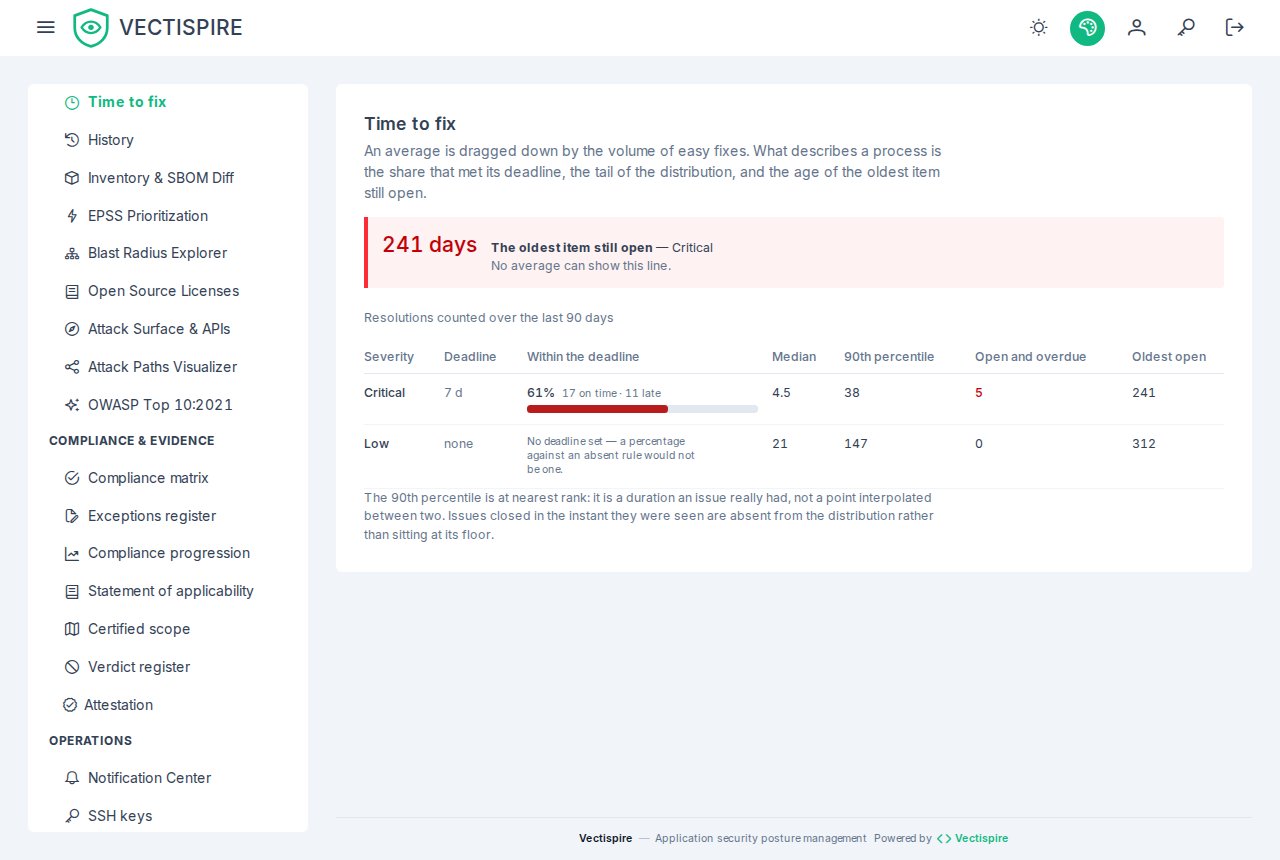
Why not an average
A mean is dragged down by the volume of easy fixes. Close forty dependency bumps in a day and the average looks excellent while the one critical nobody touched is still open.
What describes a process is three numbers, and this screen puts them on the same footing:
- the share that met its deadline, per severity;
- the 90th percentile — the tail, where the process actually fails;
- the age of the oldest item still open.
The oldest open item is at the top
It is the line no mean can show and the first an assessor asks for. Filing it in the table would make it one datum among nine.
It is highlighted when it is past the deadline of its own severity, not when it is merely old. Twenty-one days in red against a ninety-day deadline is a false alarm, and a screen that cries wolf about a target that is on time teaches people to ignore the one that is not.
Three empty states, and they are not the same
| The screen says | It means |
|---|---|
| No deadline set | Nobody gave this severity a target. A rate computed against an absent rule is not a rate, and it would be quoted as though it were. |
| Nothing to measure | The deadline exists, but nothing was resolved inside the window to measure against it. |
| 0 % | The deadline exists, work was closed, and none of it met the deadline. |
The middle case used to be shown as 0 %, which reads as "we never meet our deadlines" where the
true sentence is "nothing was closed in these ninety days".
Where the deadlines come from
The four windows are set in Settings, one per severity. They are settings rather than constants because a remediation policy is written by an organisation, not by a tool. Zero disables a severity — the help text says so on each of them, because the other reading, zero as "due immediately", turns clearing a field into a backlog entirely in breach.
A deadline that passes is also told to the SOC, once per issue, by the hourly maintenance turn —
VECTI-SEC-030 on the SIEM export, as severe as the late
issue: with the default minimum (High), a critical or high issue's breach is forwarded, a medium one's
from Medium. Only deadlines passed within the last seven days are announced, so the backlog
already late when the feature arrived, or after a window is shortened, does not reach the SOC at once.
Related
- Remediation plan — what to do, in order.
- Issues and triage — where the clock starts and stops.