Inventory and licenses
Inventory
The inventory is the estate seen from the package side rather than the target side: which components you run, in which versions, in how many places.
It answers the question that arrives on the morning a new CVE is published — do we use this, and where? — without re-scanning anything, because the SBOMs are already stored.
What the scanner cannot see, and the build can
The scanner reads the source tree. For Maven it reads the poms, so a version a parent or a BOM
manages is listed as UNKNOWN, and a library pulled in transitively is not listed at all. When the
repository's pipeline sends the SBOM its build produced (CycloneDX JSON, from cyclonedx-maven-plugin
or the Gradle CycloneDX plugin — see Importing a build's SBOM),
each scan's inventory is the scanner's completed by it: the build's stated version in place of
UNKNOWN, the transitive libraries added, what only the scanner sees kept.
Every row says who listed it. In the component search, a version marked build was stated by
the build's SBOM: hover it to read what the scanner had read instead, or whether only the build listed
the library. The project's consolidated inventory and its exports say the same per component
(sources). Older scans keep the inventory they had; the licences and the checklist lines read the
completed rows.
Licenses
License compliance is evaluated against a configurable blocklist, using data already present in the SBOM. No separate scan, no separate tool.
Configure the blocklist under Settings. What belongs on it is a decision for your organisation, not a default anybody else can supply: AGPL is fatal for a proprietary distributed product and irrelevant for an internal service that is never shipped.
A component the build's SBOM added carries the licence the build declares; where the scanner had
already listed it under UNKNOWN, the entry moves to the build's version, so it is counted once.
A license violation is a first-class finding. It counts towards the gate, and the gate policy can be set to fail a build on it.
The copyleft matrix
Licenses are resolved through a copyleft matrix rather than matched as strings, so a permissive dependency that acquired a copyleft transitive is visible as such rather than as a name nobody recognised.
SBOM drift and diff
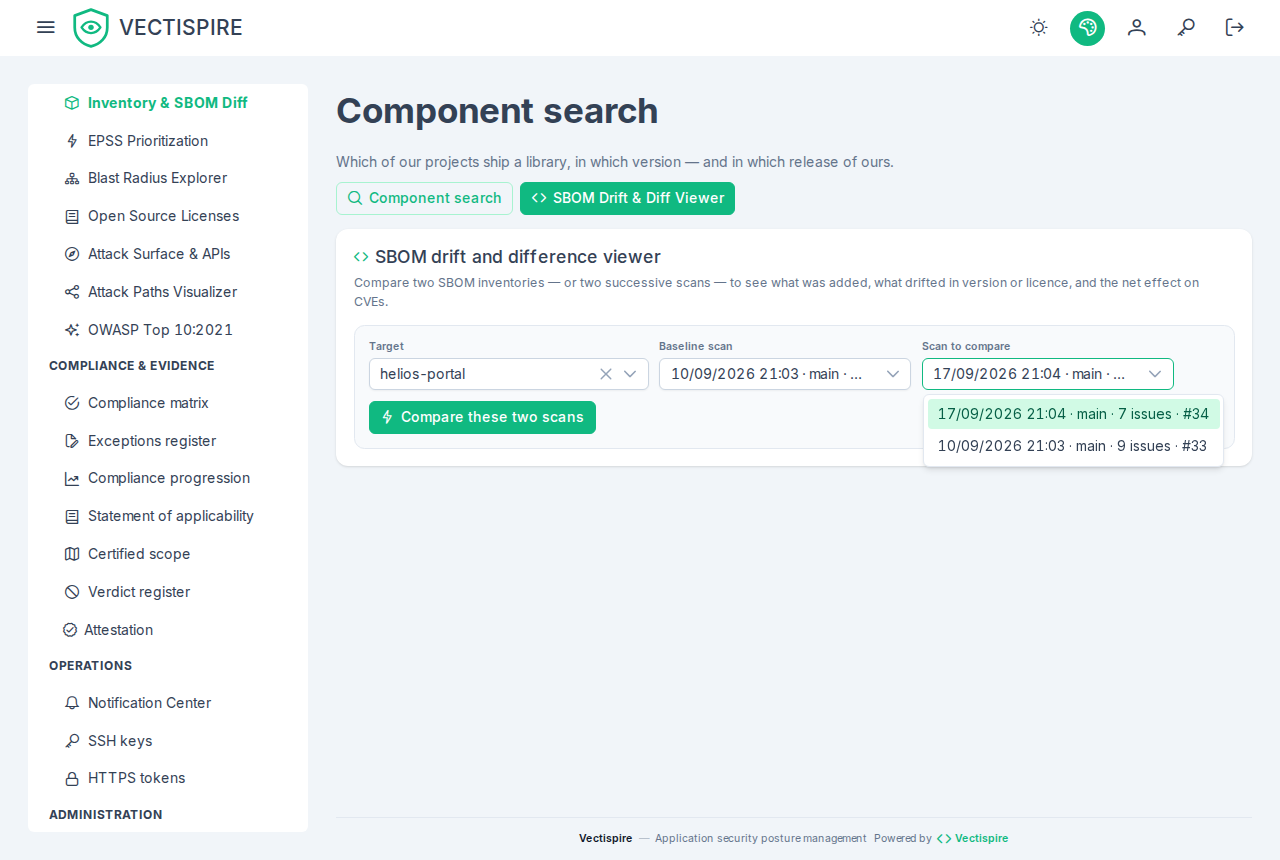
In the interface, the target comes first. Choosing a repository or an image fills two pickers with that target's own scans — the date, the branch and how many issues each one carried — and preselects the two most recent, which is the comparison almost everybody wants: what changed since last time. The other question, between the version you shipped and the one before it, is two clicks away in the same pickers.
The scan's number is still shown, at the end of each line. It is what the API takes and what a support conversation quotes; it is simply no longer the only thing on offer. This screen used to ask for two of them, typed, and nothing displayed them prominently.
A target scanned once has no pair, and the screen says so rather than leaving two empty pickers.
GET /api/v1/sbom/diff — and the equivalent viewer — compares two SBOMs and reports:
- packages added and pruned;
- license migrations, for instance permissive to GPL or AGPL copyleft;
- net CVE impact between the two.
This is the check a lockfile diff cannot give you. A dependency relicensed between two minor versions changes nothing visible in the diff of your manifest and changes everything about what you are allowed to ship.
A licence is the one a component declares — in the build's SBOM, else in the scanner's — and
UNKNOWN when it declares none; it is never guessed from the package's name. A scan whose SBOM
cannot be read is not compared: the route answers 409 with the type
urn:vectispire:problem:sbom-unreadable, rather than a comparison that would read as every
component removed or as no change.
Security debt
GET /api/v1/remediation/debt converts the open backlog into estimated engineering hours
and person-days, and highlights the top high-impact fixes — those where one action
clears the most risk.
Treat the hours as a shape rather than a quotation. Their value is in comparing two repositories or two quarters, not in filling in a project plan.