History and evidence
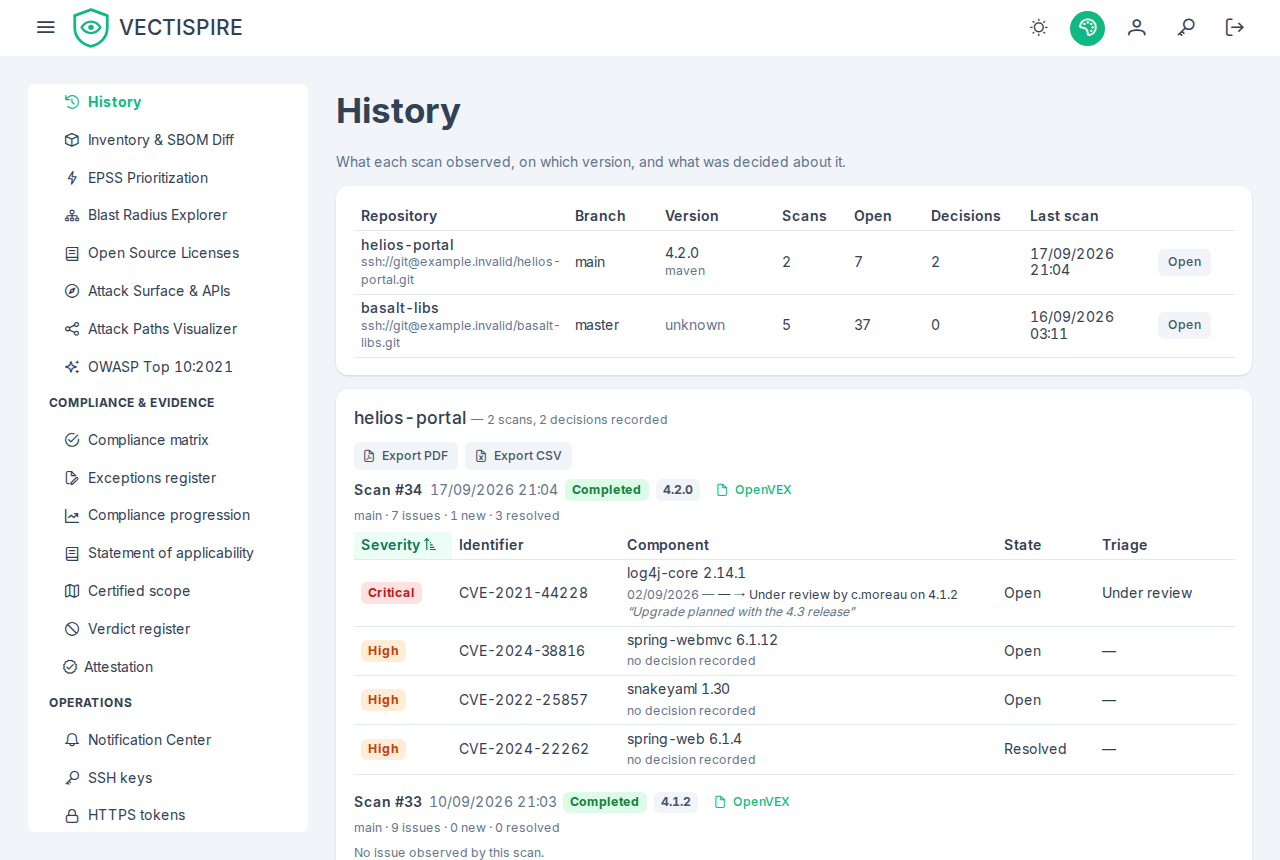
The history is the record of what was detected and what was decided, per target, kept for the reader who has to be convinced after the fact and was not there.
What it holds
Per repository, every scan, with:
- the project version that scan read;
- the issues that scan observed;
- every triage decision taken on them — from which status to which, by whom, with which justification, and against which version.
Reopenings
When a scan (or an import) finds a resolved issue again, the issue reopens, and the history
says so in a line of its own: reopened — found again by a scan or an import, resolved since
the date its resolution began. A fixed decision the return contradicted is shown as left
for under review; a judgement that survives it — not affected — is shown as kept. Nobody
is named, because nobody decided: the line is a fact about the issue, not a decision, and the
target's count of decisions leaves it out. The CSV carries it in decision_origin (reopen)
and in its last column, decision_previous_resolved_at.
A reopening before this release left no line, and the resolution it ended is not known.
Issues nobody triaged
An untriaged issue is printed as untriaged, explicitly.
That is a deliberate choice about what silence means. A history that simply omitted them would let "nobody looked at this" pass for "somebody decided it was fine and did not write it down". Those are different facts and an auditor is entitled to tell them apart.
Exporting
Both PDF and CSV.
The PDF is written for a person: an auditor, a customer's security team, an insurer. The CSV is for the analysis somebody wants to run themselves.
Related
- Issues and triage — how the decisions get recorded in the first place.
- Audit log — the tamper-evident chain underneath.
- Compliance — the framework evaluation this record supports.