Gate policies
Administration → Gate policies. One global policy, overridden per target where needed.
Who can read, who can change
Reading a policy is open to administrators, the CISO and the Auditor role. Changing one — the global policy, a per-target override, a deletion — requires an administrator or the CISO. An auditor sees exactly what the gate enforces and cannot soften it.
Stored and versioned
A policy is stored and carries a version, along with a "why", kept with the version.
The rationale field is not decoration. Six months on, "threshold: high" is a number nobody can defend; "threshold: high, because criticals in transitive dependencies were failing every build and teams had started bypassing the gate" is a decision somebody can revisit.
The rules used to arrive in the CI request body, which meant every project set its own bar and nothing was comparable. Now a request can only tighten the stored policy, never loosen it.
The built-in default
Where nothing is stored, a built-in default applies. The screen shows it beside what you have stored, so that "not set" and "set to the same thing" do not look alike — they behave identically today and diverge the moment the default changes.
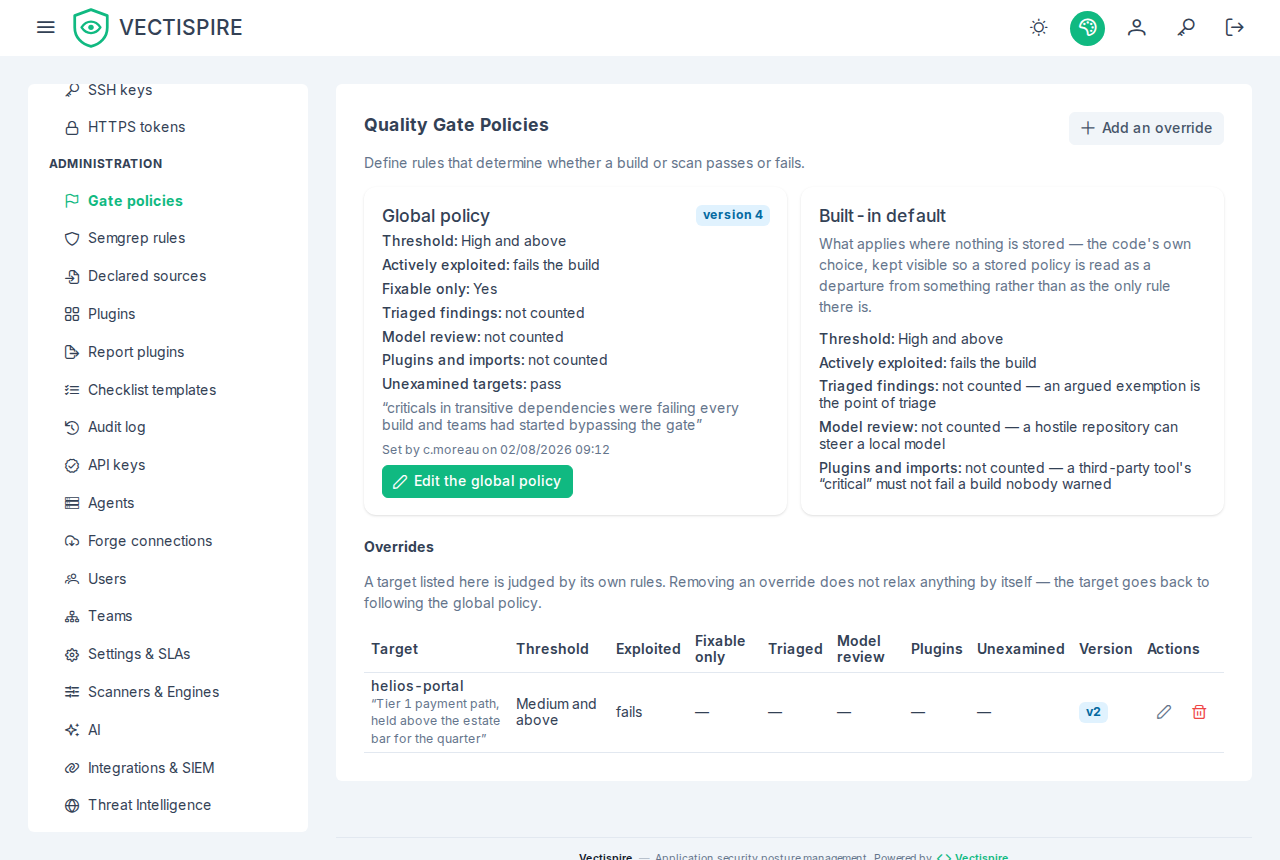
What a policy sets
| Fail the build at | the severity threshold |
| Fixable only | ignore findings with no published fix |
| Actively exploited | how KEV entries are treated |
| Triaged findings | whether a triaged issue still counts |
| License violations | fail on a blocked license |
| Model review | whether an AI review verdict participates |
Plugins (include_plugins) |
whether findings from plugins and SARIF imports participate — off by default |
Overrides
Per target. Use them for the cases the global policy genuinely cannot express — a Tier 1 service held to a stricter bar, a legacy target being brought up over a quarter.
Keep them few. An estate where every target has its own policy has no policy, and the comparison the global bar existed to make becomes impossible again.
Fixable only, in practice
Turning it on is usually right at first. Failing builds on findings with no published fix asks teams to do something nobody can do, and a gate that cannot be satisfied is a gate that gets bypassed.
Turn it off once the fixable backlog is under control — at which point unfixable criticals are a real decision about whether to ship, rather than noise.
Related
CI policy gate · Tracker tickets — which uses the same policy, deliberately.