SIEM export
Vectispire forwards the security events a SOC watches for — an actively exploited vulnerability in your estate, a build refused by the gate, a brute-force ceiling reached, a privilege or triage decision, an audit log that no longer verifies — to your SIEM, in ArcSight CEF, over a webhook or syslog.
It is configured under Settings → Integrations → SIEM, by an administrator or a security lead.
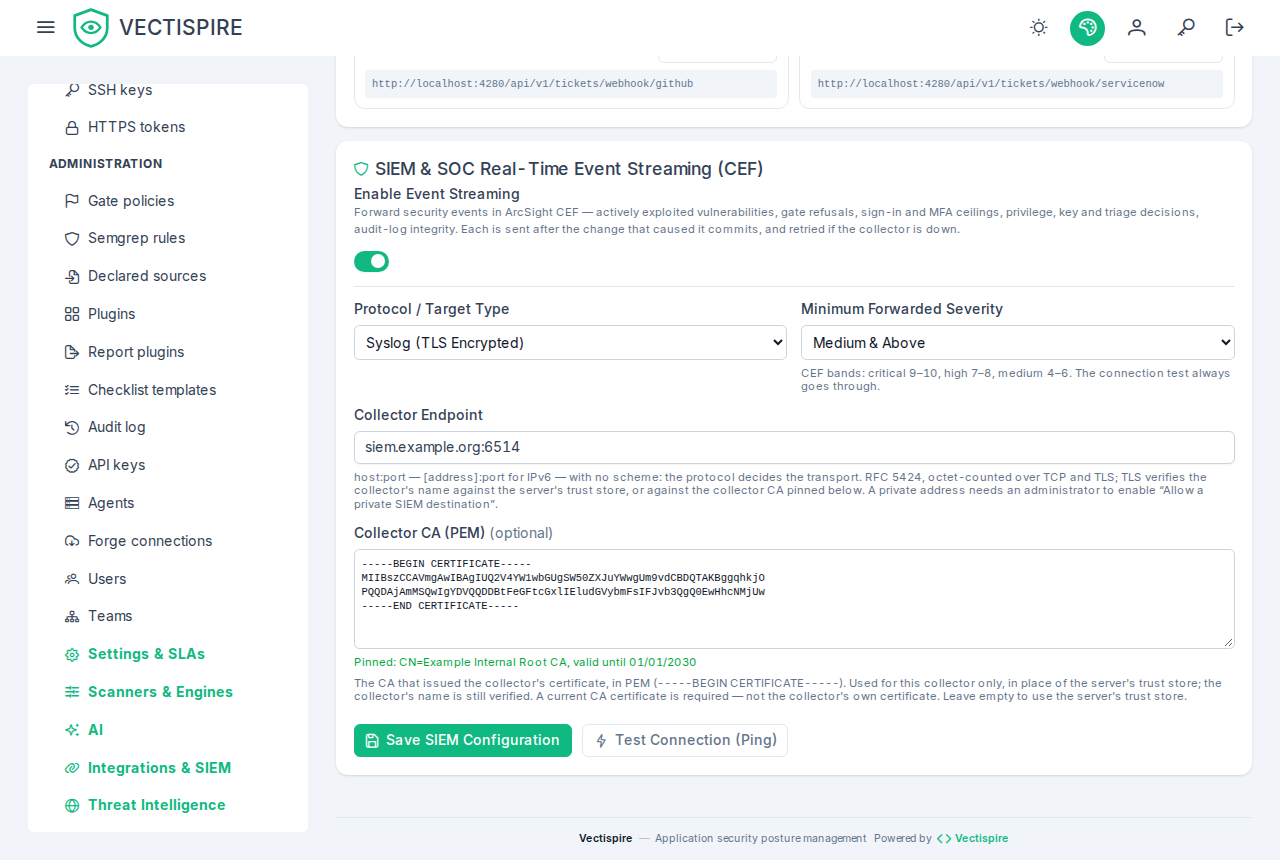
Protocols and endpoints
The protocol decides the transport, and each protocol reads one endpoint format:
| Protocol | Endpoint | What travels |
|---|---|---|
| Webhook | an https:// (or http://) URL |
a JSON POST {"cef": "<CEF line>"}, redirects refused |
| Syslog UDP | host:port |
one RFC 5424 message per datagram |
| Syslog TCP | host:port |
RFC 5424, octet-counted (RFC 6587) |
| Syslog TLS | host:port |
RFC 5424, octet-counted, inside TLS 1.2 or 1.3 |
host:port is a name or an IPv4 address and a port, for example collector.example.com:6514; an IPv6
address is written in brackets, [2001:db8::1]:514. There is no scheme — no syslog+tls:// — and the
port is required, because the defaults differ by transport (514 for UDP and TCP, 6514 for TLS) and a
guessed port is a collector that receives nothing. A malformed endpoint is refused when you save, not
at the first event.
The syslog header carries facility 10 (authpriv), a severity derived from the CEF one (very high →
critical, high → error, medium → warning, low → notice), the instance's host name, vectispire as the
application and the CEF signature identifier as MSGID, so a collector can route on the header
without parsing the payload. The message has no byte-order mark: CEF parsers expect CEF:0| at the
first byte.
UDP gives no delivery guarantee
A datagram that leaves is recorded as delivered; the network may drop it and nothing says so. Use TCP or TLS when a missed event matters.
TLS
The collector's certificate is verified against the host name you typed — hostname verification is on, whatever the trust — using the Java runtime's trust store, or the collector CA you pin.
A collector whose certificate comes from a private CA no longer needs that CA in the runtime's trust
store. Paste the CA certificate, in PEM (-----BEGIN CERTIFICATE-----), into Collector CA, shown
for Syslog TLS only. It is then used for this connection alone, and in place of the runtime's
store: the public CAs are not trusted for the collector, and nothing else Vectispire connects to —
trackers, models, webhooks — trusts the pinned CA. A bundle of a root and its intermediates is
accepted, up to 8 certificates and 16,384 characters.
The save refuses what would not work or would trust too much: a certificate that is not a CA (the collector's own certificate, which would make anybody holding a copy of it "trusted"), a CA that has expired or is not yet valid, a CA whose key usage forbids signing certificates, anything that is not a certificate — a private key pasted by mistake is refused and not echoed back — and a CA sent with another protocol. A CA is public: it is stored as written, not encrypted, and shown again with its subject and expiry. A pinned CA that expires later is not trusted any more: queued events are abandoned with the reason "the pinned SIEM collector CA is unusable … expired", and the fix is to paste the renewed CA.
Leaving the field empty removes a pinned CA; switching the protocol away from Syslog TLS removes it
too. Through the API, tlsCaPem absent from PUT /api/v1/siem/config keeps the stored one, so a
script written before the field existed does not unpin it. The connection test verifies against the
CA on the form, saved or not.
The authorization header is for the webhook only
A webhook can carry an Authorization header — Bearer <token>, Splunk <hec_token> — stored
encrypted. A syslog frame has nowhere to put one, so the field is hidden for the syslog protocols and a
header sent with one is refused. Pointing the export at a new endpoint drops the stored header unless
you type it again: a header is issued for one collector.
Private collectors
A collector on a private network — the usual case — is refused unless Allow a private SIEM destination is on. That setting is the export's own and an administrator's only: the export is configured and tested by a security lead, and the switch that decides how far it may reach is not in the same hands. It is off by default. Until 2026-09 the export followed Allow a private webhook URL, which a security lead may set; an installation whose collector is private needs an administrator to switch the new setting on after upgrading, or events are refused and the outbox reports it.
The setting is the SIEM's own, not inherited from another channel's: neither Allow a private
webhook URL (notifications) nor Allow a private tracker URL opens the internal network to the
export. Changing it is audited (SETTING_UPDATED) and forwarded as VECTI-SEC-019.
The cloud metadata address, the Docker daemon's proxy and the database are refused whatever that setting says, for syslog exactly as for the webhook: the address a name resolves to is checked once, and the connection is made to that address.
The connection test
The test sends the health-check event over the protocol on the form and answers one of three outcomes: delivered, refused by the outbound policy, or not delivered — the collector could not be reached or did not accept the event. The socket's own error — a refused connection, a timeout, an HTTP status — is written to the server log, not answered: those tell a closed port from a listening server, which would make the button a scanner of every network the export may reach.
Minimum severity
Each event carries a CEF severity from 0 to 10. The minimum severity keeps the bands at or above it:
| Setting | Forwards |
|---|---|
| Critical | 9–10 |
| High (default) | 7–10 |
| Medium | 4–10 |
| Low | everything |
The severity compared is the event's. Every type has one fixed severity, given in the
catalogue, except VECTI-SEC-030, which takes the late issue's: the threshold that
forwards an issue's severity forwards its breach.
The connection test is always sent, whatever the threshold.
Delivery
An event is written to the outbox in the same transaction as the change that caused it, and the scheduler sends it after that transaction commits — within a minute by default. Nothing is sent on the request path: a sign-in, a scan ingest or a sync never waits on your collector.
- A change that rolls back sends nothing.
- An event that cannot be written with its change does not cost the change. For an event an audit entry signals, and for a gate refusal, the change is then written on its own and the event queued right after it, in a transaction of its own — the one case where a stop at the wrong moment can still lose an event, and the only one; the server logs a warning when it happens.
- A collector that is down is retried with the outbox's backoff — eight attempts over about four hours — and then marked failed, where it stays visible.
- Delivery is at least once. A collector can accept an event and the record of that acceptance can
fail, so an event can arrive twice. Deduplicate on
externalId, which is the same on every copy. - The destination is read when the event leaves. Fixing a typo in the endpoint delivers what was waiting; switching the export off abandons what was queued.
- Switching the export off, or pointing it at another collector, tells the collector being left.
VECTI-SEC-028is sent to it at once, over its own protocol, after the change is saved and whatever the minimum severity — it is the message that explains the silence after it. It names the account and the address that made the change, never the new destination. It is best effort: a collector that is down does not keep the export on. The change's audit entry says whether the notice arrived ("stop notice delivered to the previous collector", or "NOT delivered", the cause in the server log). A notice that never arrives is itself the case to alert on: keep alerting on the absence of the feed. - Security events come from the audit log. An event exists when its audit entry does, and carries the same actor, address and target.
Wazuh
Wazuh reads Vectispire's events with the decoder and rules shipped in
ci/siem/wazuh/, checked on Wazuh 4.14 with real events sent over syslog TLS.
- Transport: Syslog TLS to an rsyslog relay on the Wazuh host. Wazuh's own syslog listener reads
neither TLS nor the octet-counted framing Vectispire uses over TCP and TLS; rsyslog reads both and writes
one line per event to a file Wazuh follows.
rsyslog-vectispire.confis the relay (its certificate must name the host you type in Vectispire; pin its CA as the collector CA),ossec-localfile.xmlthe block to add toossec.conf. Syslog UDP straight to Wazuh's listener also works, without encryption or delivery guarantee. The webhook does not: Wazuh has no HTTP input. - Decoder:
vectispire_decoders.xmlin/var/ossec/etc/decoders/. Each event givesvectispire.signature,vectispire.name,vectispire.severity,vectispire.action,vectispire.outcome,vectispire.target,vectispire.message, and the standarddstuserandsrcip. - Rules:
vectispire_rules.xmlin/var/ossec/etc/rules/, IDs 120100–120199. The level follows the CEF severity — 0–2 → 3, 3–4 → 5, 5–6 → 7, 7–8 → 10, 9–10 → 12 — so a new event type is alerted at its weight without a rule of its own; the audit log failing its integrity check (VECTI-SEC-018) is raised to 15, the credential throttles (007–009) are grouped asauthentication_failureswith MITRE T1110, a KEV detection (002) asvulnerability-detector. Correlate onvectispire.signature, never on the name.
Check a line with /var/ossec/bin/wazuh-logtest before switching the export on: phase 2 lists the
fields, phase 3 the rule and its level.
Event catalogue
The signature identifier is a contract: correlation rules are written against it, and it will not
change meaning. Its prefix changed once, from ZAN-SEC- to VECTI-SEC-, in
0.10.0 — same numbers, same meanings; see the release notes.
| Signature | Name | CEF severity | Emitted when |
|---|---|---|---|
VECTI-SEC-002 |
Actively exploited vulnerability (KEV) detected | 10 | a synchronisation of the CISA KEV catalogue — every six hours, or asked from the threat-intelligence tab — finds an open issue whose CVE it newly lists. Once per issue: a CVE already flagged is not announced again, and one the catalogue stops listing is un-flagged without an event |
VECTI-SEC-003 |
Security gate refused a build | 7 | a CI gate verdict fails |
VECTI-SEC-005 |
Finding settled by triage | 5 | a finding is marked not affected, will not fix or fixed without going through approval, by hand or by VEX import |
VECTI-SEC-006 |
MFA backup code consumed | 6 | an emergency recovery code is spent |
VECTI-SEC-007 |
Sign-in failure ceiling reached | 7 | the password throttle refuses an attempt — at sign-in, or when a signed-in account changes its password |
VECTI-SEC-008 |
MFA failure ceiling reached | 7 | a second-factor challenge is destroyed after too many wrong codes, or the account's second factor locks |
VECTI-SEC-009 |
Bearer token failure ceiling reached | 7 | an address exhausts its allowance of refused tokens — bearer or X-API-Key (once per window) |
VECTI-SEC-010 |
Account privileges or credentials changed | 6 | an account is created, deleted, changes role, activation, password, second factor or visible targets — from the screen or SCIM |
VECTI-SEC-011 |
Team access grant changed | 6 | a team's members or targets change, a repository is filed into a project or moved, or a project, repository or image that held grants is deleted |
VECTI-SEC-012 |
API key issued | 5 | an integration key is issued |
VECTI-SEC-013 |
API key revoked | 4 | an integration key is revoked — by hand, with the repository or image it was restricted to, or by a reset of its account's password (one event per key) |
VECTI-SEC-014 |
Agent declared or its credentials changed | 6 | an agent is declared, enabled, disabled, deleted, its signing key pinned or removed, or its sealing key reset by an administrator |
VECTI-SEC-015 |
Agent result refused: attestation did not verify | 8 | an agent's signed result fails verification |
VECTI-SEC-016 |
Four-eyes triage request approved | 5 | a second person settles a pending request |
VECTI-SEC-017 |
Four-eyes triage request refused | 4 | a pending request is sent back |
VECTI-SEC-018 |
Audit log integrity verification failed | 10 | a verification finds the hash chain broken or entries missing from the table |
VECTI-SEC-019 |
Security-relevant setting changed | 6 | the SIEM export itself, a gate policy, visibility, four-eyes, a private-URL or remote-model switch, a tracker or model destination, or a stored credential changes |
VECTI-SEC-020 |
Agent sealing key refused: signature or generation did not verify | 8 | an agent's sealing key announcement is refused: its signature does not verify against the pinned signing key, or it is older than the key already accepted; no credential is sealed for it |
VECTI-SEC-021 |
Analysis plugin registered, changed or activated | 6 | a plugin is registered, updated, enabled or disabled by the platform governor, allowed to run unsigned or no longer, or switched on or off for a project — third-party code gains or loses read access to some of the source |
VECTI-SEC-022 |
SARIF import source declared or changed | 6 | a SARIF source is declared, enabled, disabled or removed: which key may deposit findings, for which project or repository, from which tools |
VECTI-SEC-023 |
SARIF import refused: undeclared source, scope or tool | 5 | a SARIF upload is refused for what it claims — a key no source is declared for, a repository outside its source's scope, a tool its source is not declared for |
VECTI-SEC-024 |
Checklist template version published or retired | 6 | a checklist template version is published, or a published one retired — what every project will attest to changes. Setting a draft aside is not signalled |
VECTI-SEC-025 |
Checklist signed off | 5 | a project's checklist is signed off — a release attestation, and who gave it; the entry says whether four-eyes required the signer to be none of its authors |
VECTI-SEC-026 |
Checklist sign-off refused or returned | 5 | a sign-off is refused because the signer is one of the checklist's authors while four-eyes is on, or because a proof stopped holding since the submission; or a submitted checklist is returned to its authors |
VECTI-SEC-027 |
Report import refused: undeclared source, kind or scope | 5 | a coverage or test report is refused for what it claims — a key no enabled source is declared for, a kind its source is not declared for, a repository outside its source's scope |
VECTI-SEC-028 |
SIEM export switched off or redirected | 7 | the export is switched off, or its protocol or endpoint changes: sent synchronously to the collector being left, whatever the minimum severity (see Delivery) |
VECTI-SEC-029 |
Secret leaked in source code | 8 | a scan finds a secret of high or critical severity that is not yet an issue — every secret the bundled scanner reports is graded high. Once per issue: the same leak seen by the next scan, or come back after being resolved, is not announced again. cs3 carries the rule, msg the file; the matched value is never sent |
VECTI-SEC-030 |
Remediation deadline passed | 3–8 | an open issue nobody has settled passes its remediation deadline (first seen + the severity's window — see Remediation times). Noticed by the hourly maintenance turn, stamped with the deadline itself, once per issue. Only deadlines passed within the last seven days are announced, so the backlog already late at the upgrade — or after a window is shortened — is not announced at once; with the export off, a breach is not replayed when it is switched back on. As severe as the late issue: 8 for a critical, 7 for a high, 5 for a medium, 3 for a low — so the default minimum (High) forwards the critical and high breaches, Medium the medium ones too. An event still queued when upgrading from 0.10.0, where the severity was a fixed 6, leaves at 6 |
VECTI-SEC-031 |
Report plugin registered, changed, approved, activated or withdrawn | 6 | a report plugin is registered or given another manifest by the platform governor, a manifest digest is approved (by a second person under four-eyes), the plugin is enabled or disabled, switched on or off for a project, or a manifest is withdrawn (Report plugins) — third-party code gains or loses access to a project's whole triaged state, or the right to produce documents under the installation's key. The digest is in the message |
VECTI-SEC-032 |
Project export left the platform | 4 | a project's whole triaged state was downloaded as its signed export (Exports), or handed to a report plugin's container for a report run (Report plugins): who took it — the requester, for a run —, which project (the target is the project's id), and the SHA-256 of export.json first in the message. A run refused before its plugin started handed nothing over and raises none |
VECTI-SEC-033 |
Report plugin refused, or its output refused | 6 | a report plugin was asked to render a project and was not started: its image's signer was not verified (signature_unverified, unsigned), its registry would not be read (registry_authentication_required), or its manifest reads an export major this installation no longer produces; or it ran and wrote a file that is not what its manifest declares — another type, a macro, a zip bomb, a page dressed as a CSV — which was discarded unsigned (output_refused, the file's SHA-256 in the message) (Report plugins). How a tampered plugin shows itself. The run's id is the target; the reason and cosign's or the check's words are in the message. A run failing for an ordinary reason — an exit code, a timeout — is audited, not signalled |
VECTI-SEC-034 |
Forge connection created, its token or trust replaced, or deleted | 6 | a read-only connection to a GitHub or a GitLab (Forge connections) was created, given another token, another pinned CA or another internal-network statement, or deleted: a standing read access to an organisation's whole list of repositories appeared, changed hands or went. The message names the forge, the address, the owner, the kind of token, its scopes and CAN WRITE for a GitHub Enterprise Server classic token holding repo; never the token. A renaming is not signalled |
VECTI-SEC-035 |
Repositories imported from a forge | 5 | an administrator imported repositories from a forge connection's discovery as targets (Forge connections): many targets — and the clone credentials attached to them — created in one gesture. Once per import, never once per target: the message counts the targets, solutions and projects created and the repositories skipped, says the first scans and the clone credential per host; the connection is the target. An import that created nothing — a replay, every repository already present — is audited and not signalled |
VECTI-SEC-036 |
Forge connection refused: blocked destination, write scope, or a credential presented to another host | 5 | outcome failure: a forge connection was refused because its address resolves where no connection may go — the internal network without the administrator saying so, the metadata endpoint, Vectispire's database or Docker daemon — or because the forge reports its token with a scope beyond read-only (api, write_repository, admin:org…, or a classic token on github.com). The first is how a server-side request forgery through the form shows itself, the second a credential broader than declared. A mistyped token or an old server is not signalled |
VECTI-SEC-037 |
A tracker contradicts a settled triage decision | 4 | outcome detected: a tracker closed a linked ticket in words that contradict a decision a person settled — "won't fix" on an issue cleared as not affected, "false positive" on an accepted risk or a fix (decision 0041). The webhook moves nothing a person settled, so either the tracker or the decision is wrong: the message names the tracker, the ticket, what it said and what the issue stays. A tracker that agrees is audited and not signalled |
VECTI-SEC-999 |
SIEM connector health check | 1 | the connection test |
VECTI-SEC-001 and VECTI-SEC-004 were once declared for a secret leak and an SLA breach and never
emitted; they stay retired. The events that now carry those meanings took new numbers, 029 and
030, so that a rule written against the old declaration does not start firing on a definition it
was not written for.
Single sign-on, the MFA requirement for single sign-on and the allowed Git hosts are set by environment variables and change only with a restart, so they emit no event; their change is a deployment, not a setting.
CEF fields
CEF:0|Vectispire|ASPM|<version>|VECTI-SEC-007|Sign-in failure ceiling reached|7|rt=1790416800123 outcome=failure suser=alice src=203.0.113.7 act=LOGIN_BLOCKED cs1Label=Target cs1=alice cs2Label=UserAgent cs2=curl/8.5 externalId=5b1c… msg=Attempt refused by the throttle (300s to wait)
| Field | Carries |
|---|---|
rt |
when it happened, in epoch milliseconds |
outcome |
success, failure or detected, fixed per event type |
suser |
the account that acted, as the audit log names it |
src |
the client address the audit entry recorded (see the note below) |
act |
the audit operation (LOGIN_BLOCKED, API_KEY_CREATED…), or GATE_EVALUATED, AUDIT_VERIFIED |
cs1 / cs1Label=Target |
the resource acted upon — an issue, an account, a key, a setting, repository 12 |
cs2 / cs2Label=UserAgent |
the user agent of the request |
cs3 / cs3Label=Identifier |
a CVE, for a KEV event |
cs4 / cs4Label=Component |
the package, for a KEV event |
externalId |
the outbox message identifier — deduplicate on it |
msg |
the audit description, at most 1,024 characters |
The device version is the product version, empty when the build states none.
src behind a load balancer
An event carries the client address its audit entry recorded, resolved through
vectispire.security.trusted-proxies (see Installation):
sign-in, MFA, bearer-token and gate events, and administrative changes — keys, settings, triage —
alike. With the list empty, or a proxy in front that it does not name, that address is the
proxy's. And it is only what the closest named proxy saw: behind a load balancer or a Kubernetes
node that translates the source address (SNAT), every event names that hop rather than the
client.
Values are escaped as CEF requires — \ and = in extensions, \ and | in the header, line breaks
as \n and \r — and every other control character becomes a space. A username typed as
x\nCEF:0|…|src=6.6.6.6 arrives as one line, with src\= escaped, and cannot forge a second event
or a field.